
How to Measure Networking ROI
Ask most professionals whether their networking is producing results and you will get a vague answer. "I think so." "I have met some good people." "It is hard to say." This vagueness is a problem because it means you are investing time, money, and energy into an activity without knowing whether it is working. You would never run an advertising campaign without tracking results. You would never invest money without checking the returns. Yet most professionals network blindly — attending events, joining groups, and shaking hands without any system for measuring whether those activities are generating business.
This guide will give you a framework for measuring your networking ROI so you can double down on what works, stop what does not, and make every networking hour count. Whether you attend facilitated networking events, structured referral groups, chamber of commerce events, or informal industry meetups, the principles are the same.
Why Most Professionals Do Not Track Networking ROI
There are three common reasons professionals fail to measure their networking results, and all three are solvable.
They think networking is about relationships, not numbers. This is a false dichotomy. Tracking your networking ROI does not mean reducing every relationship to a transaction. It means understanding which relationships are productive, which activities are generating introductions, and where your time is best spent. You can value relationships deeply and still measure results. In fact, measurement helps you invest more time in the relationships that matter most.
They do not know what to track. Networking ROI is not as straightforward as advertising ROI, where you spend a dollar and measure how many dollars come back. Networking involves time, relationships, and a referral cycle that can take months to produce revenue. The metrics are different, but they are not complicated — and we will lay them out below.
They are afraid of what the numbers will show. This is the most honest reason. If you have been attending the same networking event for two years and have never tracked results, there is a good chance the numbers will be disappointing. That is uncomfortable. But knowing the truth is always better than guessing, because it gives you the power to change course.
What to Measure: The Six Networking Metrics That Matter
You do not need a dashboard or a complicated analytics platform. You need to track six numbers, and you can do it in a spreadsheet or the notes app on your phone.
1. Referrals Received
This is the most important metric. How many client referrals have you received from your networking activities in a given period? A referral is a specific, named introduction to a potential client — not a vague "I mentioned your name to someone." Track the source of every referral: which person referred them, which event or group the connection originated from, and whether the referral came through a formal referral partner or a casual connection.
2. Referrals Given
Tracking the referrals you give is just as important as tracking the ones you receive. This metric tells you how much value you are contributing to your network. It also creates accountability: if you review your numbers and realize you have given zero referrals in three months, that is a signal that you need to be more proactive about looking for opportunities to help your referral partners. As a rule of thumb, the more you give, the more you receive — but only if you are giving to the right people.
3. Deals Closed from Networking
Not every referral becomes a client. Track how many of the referrals you receive actually convert into paying clients or closed deals. This metric gives you your referral conversion rate — and it tells you a lot about the quality of the referrals you are receiving. If you are getting many referrals but few are converting, the issue may be that your referral partners do not have a clear enough understanding of your ideal client. Sharing a more specific ideal client description — as discussed in our guide on how to ask for referrals — can solve this problem.
4. Revenue Generated from Networking
This is the bottom line. How much revenue has your networking directly produced? For each closed deal that originated from a networking connection, record the revenue generated. Over time, this number gives you a clear picture of the financial return on your networking investment. It also helps you compare different networking activities: is the facilitated networking event producing more revenue per hour invested than the weekly breakfast group? You will not know unless you track it.
5. Cost Per Referral
Calculate your cost per referral by dividing your total networking investment (membership fees, event fees, travel costs, meals, and your time valued at your hourly rate) by the number of referrals received. This metric allows you to compare networking against other lead generation activities. If your cost per referral from networking is $200 and your cost per lead from Google Ads is $500, that tells you where to invest more. If the numbers are reversed, that tells you something different.
6. Time Invested
Time is the hidden cost of networking. A two-hour event actually costs you three to four hours when you factor in travel, preparation, and follow-up. Track the total time you spend on networking activities each month, including event attendance, one-on-one meetings with referral partners, follow-up calls and emails, and preparation. This gives you the denominator for calculating your hourly networking ROI: revenue generated divided by hours invested.
How to Track: Two Methods
The Simple Spreadsheet Method
For most professionals, a simple spreadsheet is all you need. Create a spreadsheet with the following columns:
Date | Event or Source | Person Met | Referral Given (to whom) | Referral Received (from whom) | Follow-Up Date | Converted (Y/N) | Revenue
Update it after every event and every referral conversation. Once a month, review the totals. This takes less than 15 minutes per week and gives you a clear picture of your networking ROI. The key is consistency — a tracking system only works if you use it every time.
The CRM Approach
If you already use a CRM (Customer Relationship Management) system for your business, add a "referral source" field to every new contact and every new deal. Tag contacts with the event or group where you met them. This allows your CRM to automatically generate reports on which networking activities are producing the most clients and revenue. Most CRMs — including HubSpot, Salesforce, and even simple tools like Pipedrive — support this kind of source tracking out of the box.
The CRM approach is more powerful than the spreadsheet method because it integrates your networking data with your overall business pipeline. You can see not just how many referrals you received, but how those referrals moved through your sales process, how long they took to close, and what their lifetime value is.
Benchmarks: What Good Looks Like
These benchmarks are based on our experience hosting over 100 facilitated networking events across South Florida and the data shared by attendees across multiple industries.
Referrals received per month: A professional with an active referral network should receive 2 to 5 qualified referrals per month. If you are below 2, you likely need more active referral partners or a clearer ideal client description. If you are above 5, your network is performing well — focus on conversion and quality.
Referral conversion rate: A healthy referral conversion rate is 40% to 60%. If you are below 40%, the referrals you are receiving may not be well-qualified — which usually means your referral partners do not understand your ideal client clearly enough. If you are above 60%, your referral partners know your practice well and are sending excellent fits.
ROI multiple: Your networking revenue should be at least 3x your total networking investment (including time valued at your hourly rate) after six months of consistent effort. For attorneys and financial advisors where individual client values are high, ROI multiples of 10x or more are common once a referral network matures.
Time to first referral from a new group or event: If you are attending a well-run networking event consistently, you should receive your first referral within 90 days. If you have been attending for six months and have received nothing, it is time to evaluate whether the group is the right fit for your practice.
When to Quit an Event or Group
Not every networking activity deserves your continued investment. The data you track will tell you when it is time to move on. Here are the signals.
No referrals after six months. If you have attended an event or group consistently for six months, followed up with the people you met, and built relationships with potential referral partners — and you have still received zero referrals — the group is not producing results for you. This does not mean the group is bad. It means the professional mix does not align with your practice. Move your time to an activity that does.
Low attendee quality. If the people attending the event are not decision-makers, do not have client bases that overlap with yours, or are primarily looking to sell to each other rather than build referral relationships, the event is unlikely to produce results regardless of how long you attend. Compare this with curated events where attendee quality is managed by the organizer.
High cost per referral. If your cost per referral from a particular activity is significantly higher than your other networking channels, it may not be worth the investment. Use your tracking data to compare activities objectively rather than relying on gut feelings or social obligations.
No reciprocity. If you are consistently giving referrals to a group or to specific partners and receiving nothing in return, your generosity is being wasted. Not every relationship will be perfectly balanced — but a complete absence of reciprocity after sustained effort is a clear signal to redirect your energy.
How Profitable Connections Helps with ROI
One of the reasons professionals see strong ROI from Profitable Connections events is that several of the ROI-killing problems described above are eliminated by the facilitated format.
The attendee directory. After every event, you receive a complete directory of attendees with their contact information and ideal referral client descriptions. This makes follow-up easy and systematic. You do not have to rely on memory or a stack of business cards — you have a structured document that tells you exactly who was in the room and what kind of clients they serve.
Pre-qualified introductions. Because the facilitator matches you with professionally compatible attendees, every conversation has referral potential. You are not wasting time on irrelevant interactions. This dramatically reduces your cost per referral and increases your conversion rate because the people you meet are pre-qualified as potential referral partners.
Post-event follow-up support. Profitable Connections follows up after events to facilitate additional introductions. This means the ROI from a single event extends well beyond the evening itself. Connections that did not happen at the event are made afterward, multiplying the value of your attendance.
Consistent, high-quality attendee base. Because Profitable Connections attracts business owners, senior professionals, and decision-makers across five South Florida locations, the quality of every conversation is high. You are meeting people who have the authority to refer clients and the client base to make those referrals valuable.
Start Tracking Today
You do not need a perfect system to start measuring your networking ROI. Open a spreadsheet, create the columns listed above, and start recording. After 90 days, review your data. You will have a clearer picture of your networking results than 95% of professionals — and you will be able to make informed decisions about where to invest your time and energy going forward.
The professionals who build the most successful practices do not network more than everyone else. They network smarter — and smart networking starts with measurement. If you are ready to invest your networking time in an activity that is designed to produce measurable results, find a Profitable Connections event near you and start building the referral network that will drive your practice forward.
Frequently Asked Questions
What is a good networking ROI?
A good networking ROI depends on your industry and average client value. As a general benchmark, if your networking activities are generating at least 3x to 5x your total investment (membership fees, event costs, time valued at your hourly rate) in closed business, your networking is performing well. For high-value professional services like law and financial advising, a single referred client can produce ROI of 10x or more. If your networking is not producing at least 2x your investment after 6 months of consistent effort, it is time to evaluate whether you are attending the right events, following up effectively, or need to change your approach.
How long before I see results from networking?
Most professionals should expect a 90-day ramp-up period before seeing their first referral from a new networking activity. The first month is about meeting people and making initial connections. The second month is about deepening those connections through follow-up and one-on-one meetings. The third month is typically when the first referrals begin to flow. If you are attending facilitated networking events where introductions are made for you, this timeline can be compressed to 30 to 60 days because the relationship-building process starts further along.
Should I track referrals given or just received?
Track both. Tracking referrals received tells you which relationships and activities are producing business for you. Tracking referrals given tells you how much value you are providing to your network — and it gives you leverage in conversations with referral partners. If you can show a partner that you have sent them five clients this year, the conversation about reciprocity becomes much easier. Tracking both directions also helps you identify imbalanced relationships that may need attention or reallocation of your time.
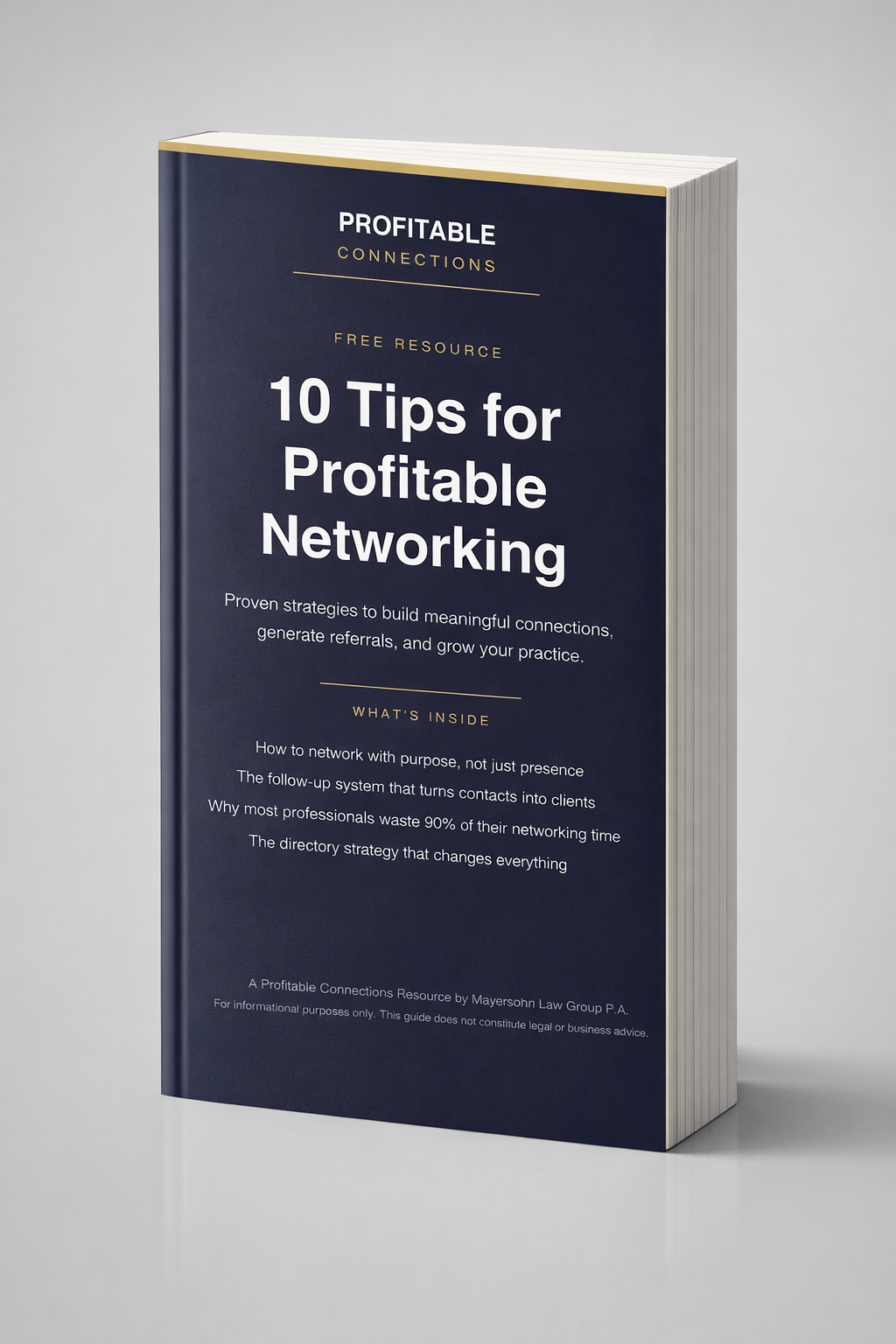
Free Guide: 10 Tips for Profitable Networking
Proven strategies to build meaningful connections, generate referrals, and grow your practice. Whether you attend our events or not, these tips will change how you network.
Get the Free GuideJoin Our Community
Stay connected between events. Join our WhatsApp and Facebook groups to share referrals, ask questions, and build relationships with South Florida professionals.
Business Professionals
For all business owners, executives, and professionals looking to build referral partnerships across South Florida.
Attorneys
Exclusively for attorneys building cross-practice referral partnerships with other legal and financial professionals.
Put This Into Practice at Your Next Event
Stop guessing whether your networking is working. Attend a Profitable Connections event, track your results, and see the difference that facilitated introductions make on your bottom line.
Find an Event Near You