
How to Ask for Business Referrals Without Being Awkward
Most professionals know that referrals are the best source of new business. They convert at higher rates, close faster, and produce longer-lasting client relationships than any other lead source. Yet the vast majority of professionals never ask for them. The reason is almost always the same: they do not know how to ask without feeling uncomfortable, pushy, or transactional.
This guide will change that. After hosting over 100 facilitated networking events across South Florida and watching thousands of professionals navigate referral conversations, we have identified the scripts, strategies, and mindsets that make asking for referrals feel natural — for both you and the person you are asking. The goal is not to become a salesperson. The goal is to make it easy for people who already respect your work to connect you with the people who need it.
Why Most Professionals Never Ask
The reluctance to ask for referrals usually comes from one of three places.
Fear of appearing desperate. Many professionals worry that asking for referrals signals that they do not have enough business. This fear is unfounded. The most successful professionals — attorneys with full practices, financial advisors with robust books of business, CPAs during off-season — all ask for referrals. Asking does not signal desperation. It signals intentionality.
Fear of damaging the relationship. There is a deeply held belief that asking someone for a referral puts pressure on the relationship. This is true only if you ask badly — if you are pushy, transactional, or vague. When you ask well, the other person actually feels good about it because you are giving them an opportunity to help someone they care about (their client, friend, or colleague) by connecting them with someone they trust (you).
Not knowing what to say. This is the most common and most solvable reason. Professionals simply do not have the words. They have never been taught how to ask, so they avoid the conversation entirely. The rest of this guide gives you exactly what to say in every common situation.
The Psychology of Asking for Referrals
Before we get to scripts, it helps to understand why referral conversations work when they do — and why they fail when they do not. The psychology boils down to three principles.
Reciprocity. People are hardwired to return favors. If you have given someone value — whether through a referral, a helpful introduction, a piece of advice, or excellent service — they feel a natural pull to reciprocate. The best time to ask for a referral is after you have given something. This is why the most effective referral networkers lead with generosity. They give first, and asking becomes almost unnecessary because the other person is already looking for ways to give back.
Specificity reduces friction. A vague ask — "Let me know if you hear of anyone who could use my services" — puts all the cognitive work on the other person. They have to figure out who in their network might be a fit, which is hard. A specific ask — "I am looking to connect with business owners who are within five years of retirement and need to plan for the sale of their company" — makes it easy. The listener can immediately scan their mental rolodex for a specific face and name. Specificity turns a vague request into an actionable one.
Permission and comfort. When you frame the ask as a question rather than a demand, and when you make it clear that saying "no one comes to mind" is completely fine, you remove all pressure from the conversation. The other person does not feel trapped or obligated. They feel invited.
When to Ask: The Three Best Moments
1. After Delivering a Strong Result
The single best time to ask for a referral is immediately after you have delivered exceptional value for a client. You have just closed a deal, resolved a legal matter, saved them money on their taxes, or helped them buy their dream home. They are grateful. They trust you. They want to help you. This is the moment of peak receptivity.
Script: "I am really glad we were able to [specific result]. Working with you has been great. I am always looking to work with more clients like you — [specific characteristic: business owners planning for retirement, families going through a transition, professionals relocating to South Florida]. If anyone in your world comes to mind, I would love an introduction."
2. At a Networking Event
Networking events — especially facilitated ones where conversations are already structured around professional compatibility — are natural environments for referral conversations. You are expected to talk about your work, and the other person is too. The key is to make the conversation mutual, not one-sided.
Script: "Tell me about the kind of client that is the best fit for your practice. I would love to know what to look for so I can send the right people your way." Then, after they have shared, reciprocate: "On my end, I work best with [specific client type]. If you come across someone in that situation, I would appreciate the introduction."
3. During a Check-In with an Existing Referral Partner
If you already have an established referral partner, quarterly check-ins are a natural time to refresh your ideal client description and gently remind them what you are looking for. This is not asking for a favor — this is maintaining a productive business relationship.
Script: "I wanted to update you on something. I have been doing a lot of work lately with [specific niche or client type], and it has been going really well. If you have clients in that space who could use help with [specific service], I would be happy to have a conversation with them. And by the way, is there anything you are working on where I could make an introduction for you?"
The Ideal Client Description Technique
This is the single most effective strategy for generating referrals, and most professionals have never done it. An ideal client description is a two-to-three sentence portrait of the exact type of person you serve best. It is specific enough that someone who hears it can immediately picture a real person in their network.
Bad example: "I am a financial advisor and I work with anyone who wants to grow their wealth."
Good example: "I work with business owners in South Florida who have built companies worth $2 million to $20 million and are starting to think about what happens when they are ready to step away. They usually have most of their net worth tied up in the business and need a plan to convert that into personal financial security."
The difference is stark. The first description is so broad that no one can act on it. The second description is so specific that a CPA, attorney, or business consultant hearing it would immediately think, "I know someone exactly like that." Specificity is the catalyst that turns a polite conversation into an actual referral.
Prepare your ideal client description before you attend any networking event. Practice saying it aloud until it feels natural. Share it with every referral partner. Update it as your practice evolves. This single tool will generate more referrals than any other technique in this guide. For more strategies, download our free guide to profitable networking.
Scripts for Specific Situations
Asking a Satisfied Client
"Thank you for trusting me with [the matter]. I really enjoyed working with you. I build my practice primarily through referrals from clients who have had a good experience. If you know anyone — a colleague, friend, or family member — who is dealing with [specific problem you solve], I would welcome the chance to help them the way I helped you."
Asking a Professional Contact Who Has Never Referred You
"I have really enjoyed getting to know you over the past [timeframe]. I think there is a natural overlap between the clients we serve. I am curious — have you ever had a client mention needing help with [your area of expertise]? If so, I would love to be the person you send them to. And I am always looking for opportunities to return the favor."
Asking at a Networking Event (Cold)
"Tell me about your practice — who is the ideal client for you? I like to know because if I run across someone who fits, I want to be able to send them your way." After they share and ask about you: "I specialize in [your ideal client description]. The clients I help most are usually referred by [types of professionals — CPAs, attorneys, financial advisors]. If anyone comes to mind, I would appreciate the connection."
Re-Engaging a Dormant Referral Relationship
"It has been a while since we connected, and I wanted to reach out. I have been doing some great work with [specific client type or project] and it reminded me of a conversation we had about [shared interest or client overlap]. Are you still working with [specific type of client]? I would love to catch up and see if there are ways we can help each other again."
What to Do After You Receive a Referral
How you handle a referral determines whether you will ever receive another one from that person. This is where many professionals fail — not in the asking, but in the follow-through.
Contact the referral immediately. Within 24 hours, reach out to the person who was referred to you. Mention who sent them and express appreciation for the introduction. Speed signals professionalism and respect for the referring partner's reputation.
Thank the referrer personally. A quick phone call, text, or handwritten note to the person who made the referral goes a long way. Do not send a generic email. Make it personal and specific: "Thank you for introducing me to [name]. I spoke with them today and I think I can really help with [their situation]. I appreciate your confidence in me."
Close the loop. After you have had the initial conversation with the referred client, let the referrer know the outcome — within the limits of confidentiality. Did the client engage your services? Were they a good fit? This feedback loop gives your referral partner confidence that their introductions are valuable and well-placed.
Reciprocate. The best thank-you for a referral is another referral. Actively look for opportunities to send business back to the person who sent it to you. This is how one-time favors become ongoing referral networking relationships that sustain your practice for years.
Building a System That Makes Asking Unnecessary
The ultimate goal of referral networking is to reach a point where you rarely have to ask because your network is actively thinking about you when they encounter someone who needs your services. This happens when you have built genuine trust with a core group of referral partners, consistently delivered excellent service to referred clients, and maintained regular communication with your network.
The professionals who reach this level are not more talented or more charismatic than everyone else. They are simply more consistent. They show up to events. They follow up after meetings. They send referrals before asking for them. They keep their ideal client description clear and current. And they treat every referral like the gift it is.
If you want to accelerate this process, attend a facilitated networking event where the conversations are structured to help you build these relationships faster. At Profitable Connections, every event is designed to help professionals identify, meet, and build relationships with ideal referral partners across five South Florida locations.
Frequently Asked Questions
When is the best time to ask for a referral?
The best time to ask for a referral is immediately after you have delivered a strong result for a client or after a referral partner has expressed satisfaction with your work. The moment of peak gratitude is when people are most willing to help. Other good times include during a quarterly check-in with a referral partner, after providing value to someone in your network, or at a networking event where the conversation has naturally turned to discussing your respective practices.
What if they say no to my referral request?
A "no" to a referral request is rarely personal. It usually means the person does not currently know anyone who fits your description, or they do not yet feel confident enough in your work to put their reputation on the line. Respond gracefully, thank them for their honesty, and continue building the relationship. Over time, as they see more of your work and hear more about your results, the comfort level will increase. Never pressure someone into giving a referral — a forced referral is worse than no referral at all.
Should I offer compensation for referrals?
In most professional services industries, paying for referrals is either ethically prohibited or creates the wrong incentive. Attorneys, financial advisors, and CPAs all operate under ethical rules that restrict or prohibit referral fees. Even in industries where compensation is allowed, paying for referrals can turn a trust-based relationship into a transactional one. The best referral relationships are built on mutual benefit and genuine confidence in each other's work, not financial incentives. Instead of paying for referrals, focus on reciprocating — send referrals back, provide value, and maintain the relationship.
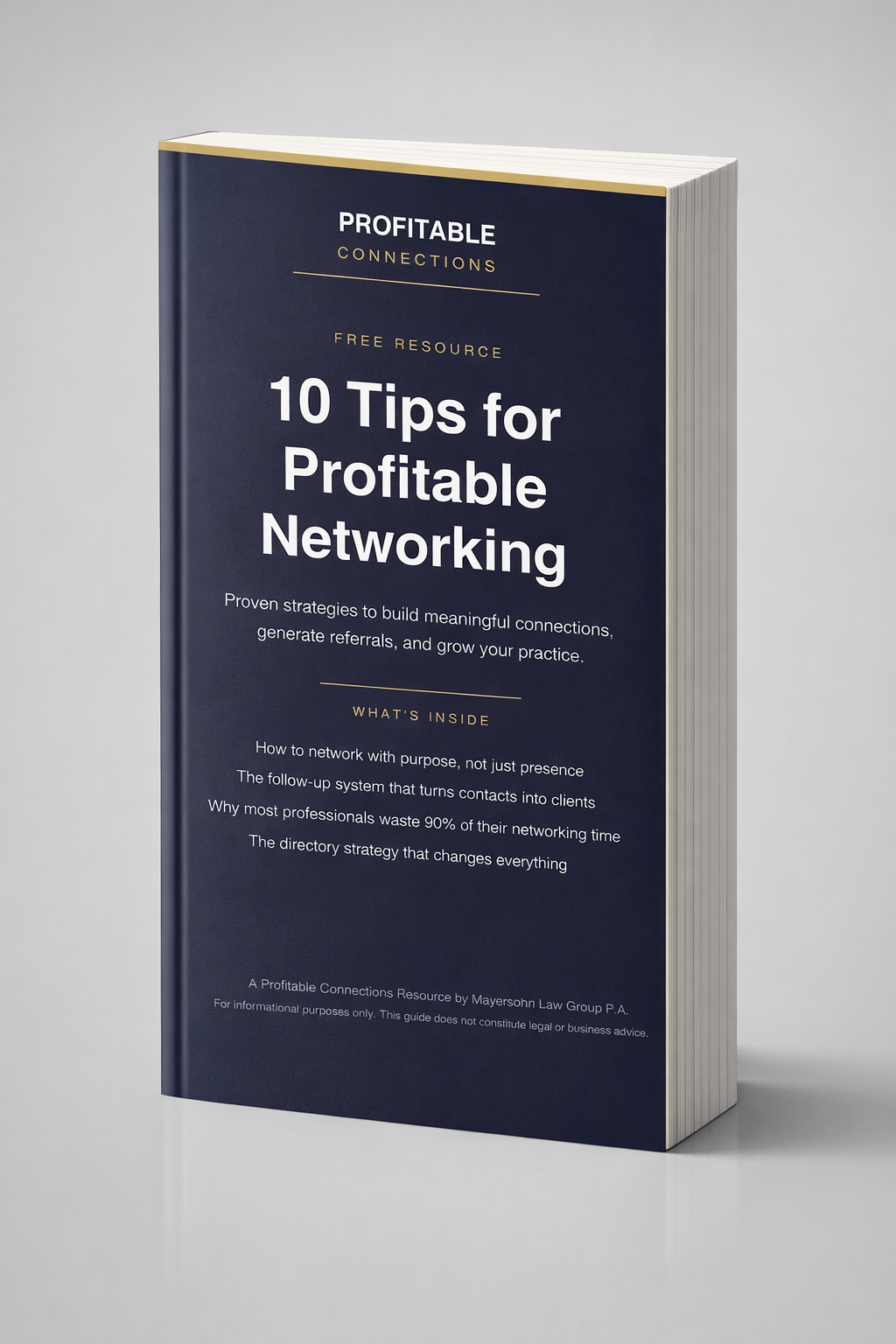
Free Guide: 10 Tips for Profitable Networking
Proven strategies to build meaningful connections, generate referrals, and grow your practice. Whether you attend our events or not, these tips will change how you network.
Get the Free GuideJoin Our Community
Stay connected between events. Join our WhatsApp and Facebook groups to share referrals, ask questions, and build relationships with South Florida professionals.
Business Professionals
For all business owners, executives, and professionals looking to build referral partnerships across South Florida.
Attorneys
Exclusively for attorneys building cross-practice referral partnerships with other legal and financial professionals.
Put This Into Practice at Your Next Event
The best way to practice asking for referrals is in a room full of professionals who are there for the same reason. Profitable Connections facilitates the introductions so the conversation starts naturally.
Find an Event Near You