
What Is Facilitated Networking?
Facilitated networking is a structured approach to professional networking where a host or organizer actively introduces attendees to each other based on professional compatibility, rather than leaving introductions to chance. In a facilitated networking event, the organizer learns about each attendee's practice, their ideal clients, and the types of professionals they want to meet — before the event takes place. During the event, the facilitator makes targeted, one-on-one introductions, ensuring that every conversation has context and purpose.
This stands in sharp contrast to traditional networking events — open mixers, chamber of commerce happy hours, and industry conferences — where attendees are left to wander the room and introduce themselves. In a traditional format, the quality of your experience depends entirely on luck: who happens to be standing next to you, whether you can work up the courage to approach a stranger, and whether the conversation turns out to be relevant. Most of the time, it does not.
Facilitated networking eliminates that randomness. Every introduction is intentional. Every conversation starts with shared professional context. And every attendee leaves with connections that have a realistic chance of turning into referral partnerships — not just a stack of business cards from people they will never contact again.
How Facilitated Networking Works
The facilitated model follows a three-phase process that transforms the networking experience from passive to strategic.
Phase 1: Pre-Event Profiling
Before the event, every attendee provides information about their profession, the clients they serve, and the types of professionals they want to meet. This is not a generic RSVP form. It is a structured intake that asks specific questions: What is your ideal client? What profession would be your ideal referral partner? Is there anyone specific you are hoping to connect with?
This information gives the facilitator a complete picture of who is in the room and how they might benefit from knowing each other. A financial advisor who specializes in retirement planning for business owners, for example, can be matched with a business attorney who handles succession planning and a CPA who works with the same demographic. The connections are obvious once you have the data — but without the profiling step, those three professionals might attend the same event and never find each other.
Phase 2: Intentional Matching
Using the information collected during profiling, the facilitator identifies the highest-value connections for each attendee. This is not random pairing. It is strategic matching based on professional complementarity — the degree to which two professionals serve overlapping client bases in non-competing ways.
The facilitator looks for natural alignments. An estate planning attorney and a wealth manager both serve high-net-worth individuals. A real estate agent and a mortgage lender both serve homebuyers. A business consultant and an insurance agent both serve small business owners. These are the pairings that produce referral partnerships — and the facilitator ensures they happen during the event rather than leaving them to chance.
Phase 3: Structured Introductions
During the event, the facilitator makes direct introductions. These are not generic "you two should talk" moments. They are contextualized introductions that explain why two people should know each other: "Sarah is an estate planning attorney who specializes in trusts for business owners. David manages investment portfolios for business owners who are planning to exit. You serve the same client at different stages — I think you should get to know each other."
This context changes everything. Instead of two strangers making small talk about the weather or exchanging elevator pitches, both parties immediately understand why the conversation matters. The introduction has substance before a single word is spoken. This accelerates trust-building and dramatically increases the likelihood that the connection will develop into a productive referral networking relationship.
Why Facilitated Networking Outperforms Open Networking
The comparison between facilitated and traditional networking is not even close when you measure what actually matters: referral partnerships formed, clients referred, and revenue generated.
Higher conversion rate. At a traditional networking event, you might have 15 conversations and leave with 2 follow-ups. At a facilitated event, you might have 5 conversations and leave with 4 follow-ups. The difference is that every conversation at a facilitated event has been pre-screened for relevance. You are not wasting time talking to people who have no professional overlap with you.
Better first impressions. When a facilitator introduces you with context — explaining your practice, your expertise, and why the other person should care — you start the conversation with credibility. Compare that to walking up to a stranger at a mixer and trying to explain who you are and why they should care, all within the first 30 seconds. The facilitated introduction does the hard part for you.
Reduced anxiety. Many professionals — particularly those who identify as introverts — dread traditional networking events. The prospect of approaching strangers, making small talk, and "working the room" is genuinely stressful. Facilitated networking removes that barrier entirely. You do not need to approach anyone. The facilitator brings people to you, introduces you with context, and gives both parties a natural starting point for conversation.
Time efficiency. Busy professionals cannot afford to spend two hours at an event and leave with nothing to show for it. Facilitated networking respects your time by ensuring that every minute is spent in a conversation that has professional value. There is no wandering, no small talk with people who cannot help you (and whom you cannot help), and no awkward standing alone by the appetizer table.
The Facilitator's Role
A good facilitator is not just a host. They are part matchmaker, part connector, and part coach. Their job is to understand every person in the room well enough to identify the highest-value connections and then make those connections happen with skill and grace.
At Profitable Connections, Leah Mayersohn personally facilitates introductions at every event. With 30+ years as a practicing attorney in South Florida, she understands the professional landscape deeply enough to recognize which pairings have the potential to generate real business. She does not just introduce people — she explains why they should know each other, provides context that both parties can build on, and follows up after the event to facilitate additional connections.
The facilitator also manages the room dynamics. They ensure that no one is left standing alone. They intervene when a conversation has run its course to connect each party with someone new. They balance the energy of the room so that every attendee has multiple meaningful interactions during the event. This level of active management is what separates facilitated networking from curated but passive networking formats.
How Profitable Connections Implements Facilitated Networking
Profitable Connections hosts facilitated networking events across five South Florida locations: Fort Lauderdale, Miami, Boca Raton, Palm Beach, and virtually via Zoom. Each event follows the facilitated model described above, with several additional features that amplify the value.
Attendee directory. After every event, attendees receive a complete directory of everyone who was in the room — including names, contact information, companies, and ideal referral client descriptions. This directory is the foundation for post-event follow-up and turns a single event into weeks of productive outreach.
Post-event follow-up. A dedicated team member follows up after each event to facilitate additional introductions that may not have happened during the event itself. If the facilitator noticed two people who should have connected but ran out of time, that introduction is made after the fact. The networking does not end when you leave the room.
Consistent attendee quality. Because Profitable Connections attracts decision-makers, business owners, and senior professionals — not junior employees or people who are simply looking for a free drink — the quality of every conversation is high. You are meeting people who have the authority and the client base to actually send you referrals.
Who Benefits Most from Facilitated Networking
Introverts
If the thought of walking into a room full of strangers and "working the room" fills you with dread, facilitated networking was designed for you. The facilitator handles the hard part — identifying who you should meet and making the introduction. All you have to do is show up and have a conversation that someone else has already set up for you.
Busy Professionals
If your time is limited and you cannot afford to spend hours at events that may or may not produce results, facilitated networking offers a dramatically better return on your investment. Every conversation is pre-qualified for professional relevance, so your time is never wasted on random interactions.
Professionals New to an Area
If you have recently moved to South Florida — or expanded your practice to a new market — you do not have the established network that longtime residents take for granted. Facilitated networking accelerates the relationship-building process by placing you directly in front of the professionals who are most likely to become productive referral partners. What would normally take a year of organic networking can happen in a matter of weeks.
Anyone Who Has Tried Traditional Networking and Given Up
If you have attended open mixers, chamber events, or structured networking groups and come away disappointed, facilitated networking is worth trying before you conclude that networking does not work. In most cases, the format was the problem — not the concept. When introductions are intentional rather than random, the results are dramatically different.
Getting Started with Facilitated Networking
The best way to experience facilitated networking is to attend an event. Profitable Connections hosts events weekly across South Florida, and each one is designed to help professionals like you build the referral partnerships that drive sustainable growth. You will be profiled before the event, matched with compatible professionals, and introduced with context — so you can skip the awkward small talk and go straight to the conversations that matter.
To learn more about how to prepare for your first facilitated networking event and make the most of every introduction, download our free guide to profitable networking. And when you are ready to experience the difference for yourself, find an event near you and learn how to ask for referrals naturally once you are in the room.
Frequently Asked Questions
Is facilitated networking only for introverts?
No. While introverts particularly appreciate facilitated networking because it removes the anxiety of approaching strangers, extroverts benefit just as much. The advantage for extroverts is efficiency — instead of spending time in enjoyable but unproductive conversations with whoever happens to be nearby, facilitated networking ensures that their social energy is directed toward the people most likely to become productive referral partners. Both personality types report higher satisfaction and better outcomes from facilitated events compared to open mixers.
How does the facilitator know who to match?
At Profitable Connections, we collect information from every attendee before the event: their profession, their ideal client profile, the types of professionals they want to meet, and any specific introductions they are looking for. The facilitator reviews this information and identifies natural alignments — a CPA who serves small business owners paired with a business attorney who does the same, or a financial advisor looking for estate planning referral partners matched with an estate planning attorney. The matching is intentional and based on professional compatibility, not random assignment.
What if I already know people at the event?
That is actually an advantage. If you already know some attendees, the facilitator can focus on introducing you to the people you have not met yet. Existing connections also provide social proof — when someone you know is in the room, it increases your credibility with new contacts. Many regular attendees at Profitable Connections events use them as an opportunity to deepen existing relationships while simultaneously meeting new potential referral partners.
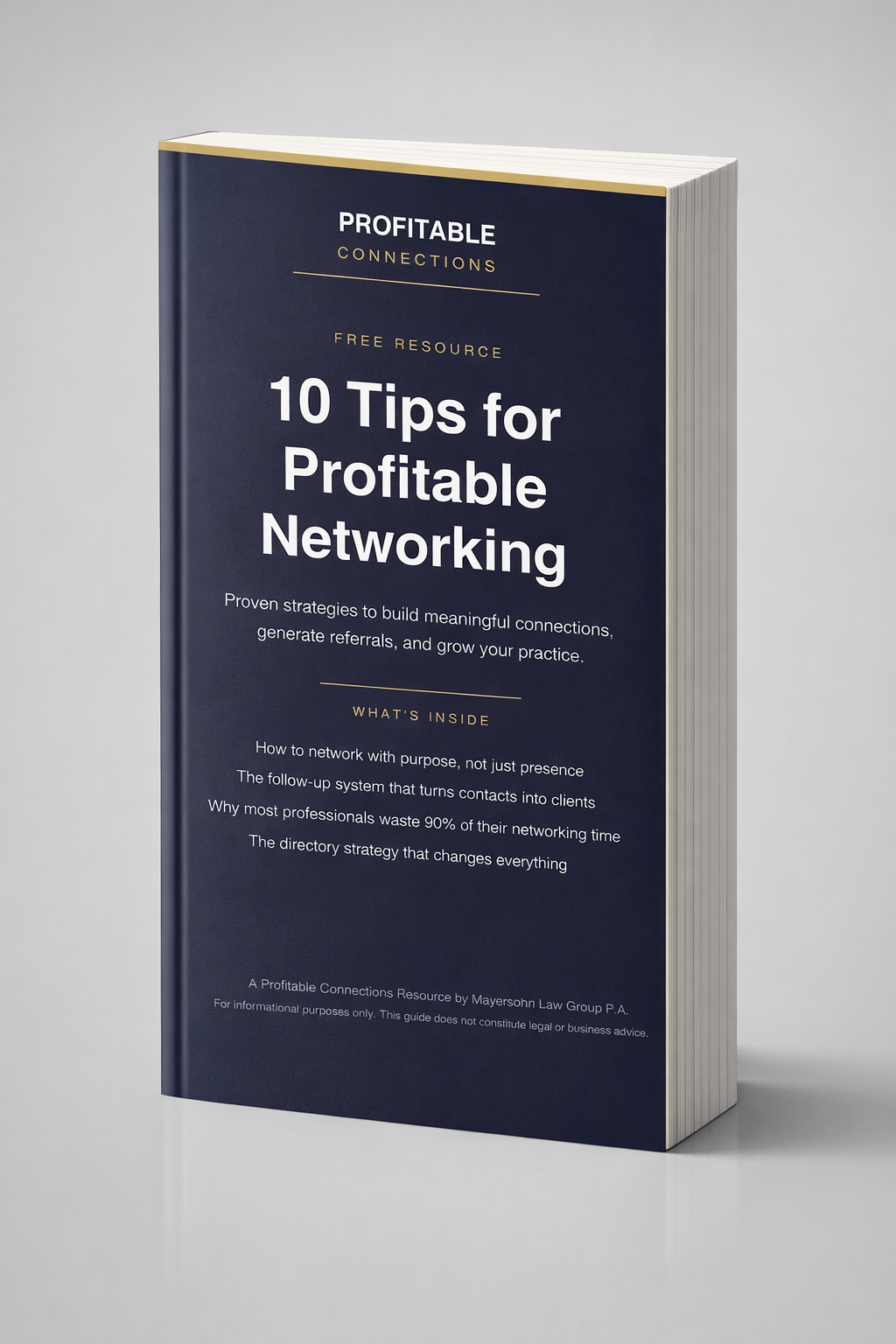
Free Guide: 10 Tips for Profitable Networking
Proven strategies to build meaningful connections, generate referrals, and grow your practice. Whether you attend our events or not, these tips will change how you network.
Get the Free GuideJoin Our Community
Stay connected between events. Join our WhatsApp and Facebook groups to share referrals, ask questions, and build relationships with South Florida professionals.
Business Professionals
For all business owners, executives, and professionals looking to build referral partnerships across South Florida.
Attorneys
Exclusively for attorneys building cross-practice referral partnerships with other legal and financial professionals.
Put This Into Practice at Your Next Event
Experience the difference that facilitated introductions make. Profitable Connections events are designed to connect you with the professionals who can send you business — without the awkwardness of traditional mixers.
Find an Event Near You